Blog
Lachhiman Gurung VC: The Legend Who Stood Alone Against 200 – A Story of Unbreakable Courage

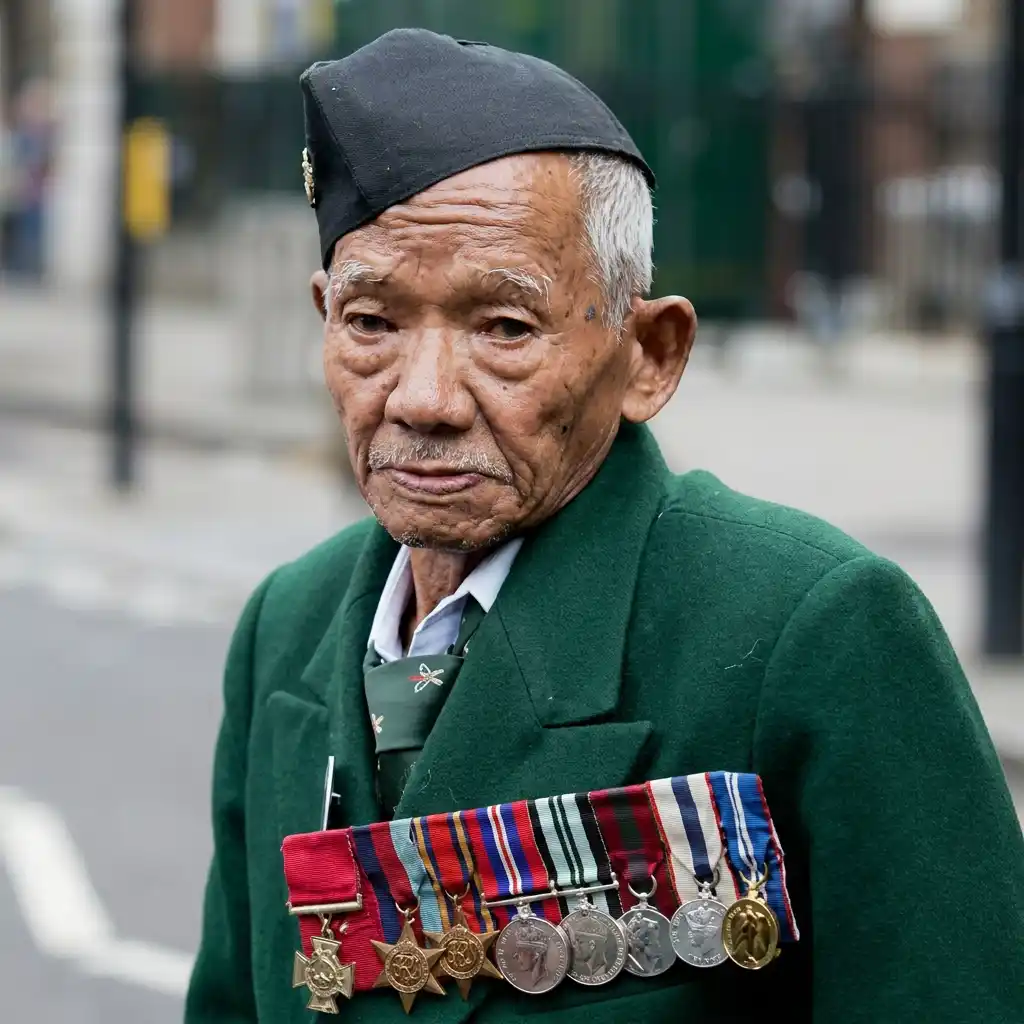
“I felt I was going to die anyway, so I might as well die standing on my feet.”
These words, spoken by a 4-foot-11-inch Gurkha rifleman who lost his right hand and eye in battle, define what it means to embody courage against impossible odds. This is the extraordinary story of Lachhiman Gurung, one of the most decorated Gurkha warriors in history, whose single act of defiance changed the course of a battle and became legend.
From the Himalayas to the Battlefield
Born on December 30, 1917, in the remote village of Dahakhani (now Ichchhakamana Rural Municipality) in Nepal’s Chitwan District, Lachhiman Gurung grew up in the shadow of the Himalayas. His father, Partiman Gurung, like many in their community, understood that military service represented both honor and opportunity for hill families in Nepal.
In December 1940, at age 23, young Lachhiman presented himself for enlistment in the British Indian Army. There was one problem: he stood just 4 feet 11 inches tall—one inch below the peacetime minimum height requirement for Gurkha recruits. But this was wartime, and the recruiters saw something in the young man that transcended physical stature. They were right to look beyond the measuring tape.
After completing rigorous basic training, Gurung was assigned to the 4th Battalion, 8th Gurkha Rifles—a regiment with a distinguished lineage dating back to 1824. The 8th Gurkha Rifles had already earned battle honors across two world wars, establishing a reputation for toughness and adaptability that made them ideally suited for jungle warfare.
The Burma Campaign: The Forgotten War
By 1945, the Burma Campaign had become one of the most brutal and demanding theaters of World War II. Fought across dense jungle, steep mountains, monsoon-soaked valleys, and primitive supply routes, it tested men to their absolute limits. Yet it would later be called “the forgotten war”—overshadowed by the campaigns in Europe and the Pacific.
General William Slim’s 14th Army, nicknamed the “Forgotten Army,” was pushing deep into Japanese-held Burma. After halting the Japanese offensives at Imphal and Kohima in 1944, Allied forces had turned the tide and were now relentlessly driving the enemy back toward Thailand. But the Japanese, though exhausted and undersupplied, remained dangerous adversaries who refused to concede defeat.
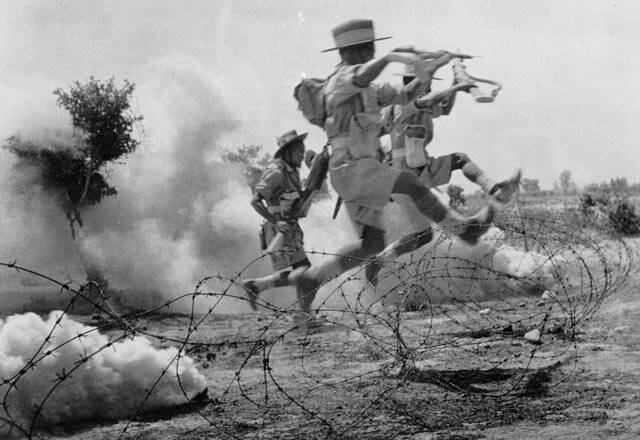
The Japanese doctrine emphasized aggressive night attacks, infiltration tactics, and a willingness to fight to the death rather than surrender. Small-unit actions often decided local control, with grenades, bayonets, and close-quarters combat playing decisive roles. This was the unforgiving battlefield where Rifleman Lachhiman Gurung would write his name into military history.
The Night of May 12-13, 1945: Taungdaw
In late April 1945, the 89th Indian Infantry Brigade of the 7th Indian Division received orders to cross the Irrawaddy River and destroy Japanese forces withdrawing north of the Prome-Taungup road. By May 9, after a series of desperate attacks, the Japanese had broken contact and were retreating toward the Taungdaw Valley.
The 4th Battalion, 8th Gurkha Rifles positioned B and C Companies to block the enemy’s escape route at the village of Taungdaw, on the west bank of the Irrawaddy River. When approximately 200 Japanese soldiers arrived, they quickly surrounded the two Gurkha companies, cutting off their lines of communication. The Gurkhas were isolated, outnumbered, and facing an enemy with nothing to lose.
Rifleman Lachhiman Gurung, who had joined the company just two months earlier as part of a reinforcement draft, was positioned at the most forward post of his platoon—almost 100 yards ahead of the main company position. He shared this exposed trench with two other Gurkhas, manning what was essentially the key to the entire defensive line. If this position fell, the entire reverse slope would be dominated, exposing the right flank of the battalion and potentially the entire brigade to devastating enfilade fire.
Four Hours That Defined a Legend
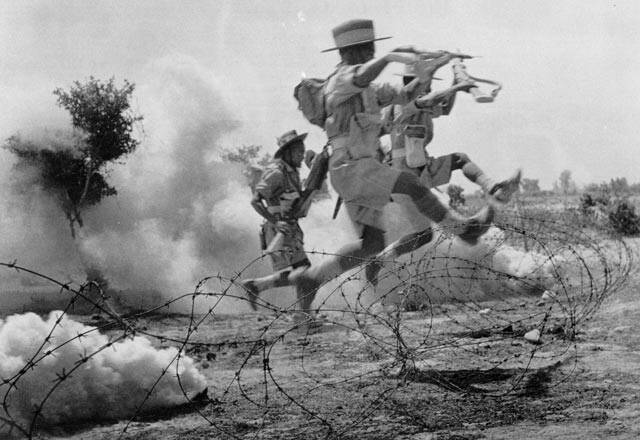
At 1:20 AM on May 13, the jungle erupted with the sounds of a massive Japanese assault. More than 200 enemy soldiers, screaming battle cries, launched a concerted attack from the jungle path. Before they could close with the Gurkha positions, they had to cross 30 yards of open ground—which they peppered with grenades.
The first grenade landed on the lip of Gurung’s trench. Without hesitation, he snatched it up and hurled it back at the attackers. Almost immediately, a second grenade fell directly inside the trench. Again, Gurung grabbed it and threw it back toward the enemy. Then came the third grenade.
This one landed just in front of the trench. Gurung reached for it, attempting to throw it back before it detonated. But time ran out.
The explosion was catastrophic. The grenade detonated in his right hand, blowing off his fingers, shattering his right arm, and sending shrapnel tearing through his face, body, and right leg. Blood poured from his wounds. His two companions in the trench were also badly wounded and unable to continue fighting.
Lachhiman Gurung was alone, grievously wounded, and facing wave after wave of Japanese infantry determined to break through his position.
“Come and Fight a Gurkha!”
What happened next defies comprehension.
Despite catastrophic injuries, despite bleeding heavily, despite being unable to see clearly from his facial wounds, Rifleman Gurung made a decision that would echo through military history. In some accounts, he drove his kukri—the traditional curved knife of the Gurkhas—into the ground in front of his position and declared to the advancing Japanese that they would not pass.
Then, using only his left hand, he began to work his bolt-action rifle.
Loading and firing a bolt-action rifle with one hand is extraordinarily difficult even under ideal conditions. The Lee-Enfield rifle Gurung was using was designed for right-handed operation, requiring the shooter to work the bolt with the right hand while the left steadied the weapon and pulled the trigger. Gurung, gravely wounded and working in darkness, had to reverse this entire process.
For four hours, this diminutive Gurkha held his post alone. His comrades 100 yards back could hear him taunting the enemy between rifle shots: “Come and fight! Come and fight! I will kill you!” and “Come and fight a Gurkha!”
Wave after wave of Japanese soldiers rushed his position. Wave after wave, Gurung drove them back with accurate fire at point-blank range. His magnificent example inspired his surrounded comrades to resist with equal ferocity. Although cut off for three days and two nights, the company held firm and smashed every attack.
Dawn Reveals the Impossible
When dawn finally broke on May 13 and the firing ceased, the sight that greeted relieving forces was extraordinary. Of the 87 Japanese soldiers counted dead in the immediate vicinity of the company’s position, 31 lay directly in front of Lachhiman Gurung’s trench—testimony to the devastating effectiveness of his one-handed defense.
The tactical significance was immense. Gurung’s refusal to yield had prevented a breakthrough that could have compromised the entire battalion’s position and delayed the Allied advance northward. His commanding officer, Lieutenant-Colonel W.C. Walker (who would later become General Sir Walter Walker KCB CBE DSO**), recognized immediately that he had witnessed something exceptional.
The young rifleman was evacuated to hospital, where doctors worked to save his life. He would survive, but at a terrible cost: he lost his right hand entirely, permanently lost the use of his right eye, and carried the scars of his wounds for the rest of his life.
The Victoria Cross: Britain’s Highest Honor
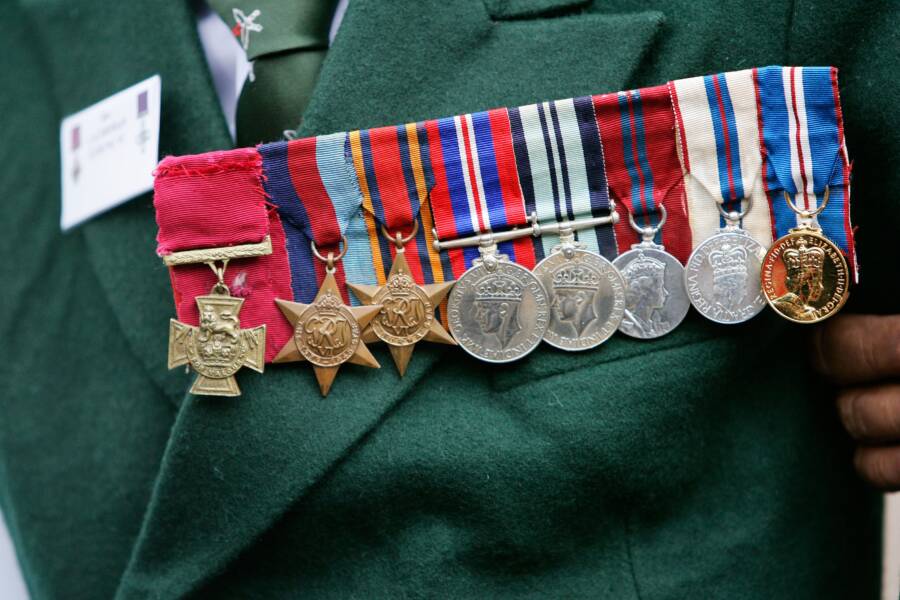
On May 19, 1945—just six days after the battle—Lieutenant-Colonel Walker signed the recommendation for Britain’s highest military decoration: the Victoria Cross. The citation read in part:
“Of the 87 enemy dead counted in the immediate vicinity of the Company locality, 31 lay in front of this Rifleman’s section, the key to the whole position. Had the enemy succeeded in over-running and occupying Rifleman Lachhiman Gurung’s trench, the whole of the reverse slope position would have been completely dominated and turned. This Rifleman, by his magnificent example, so inspired his comrades to resist the enemy to the last, that, although surrounded and cut off for three days and two nights, they held and smashed every attack. His outstanding gallantry and extreme devotion to duty, in the face of almost overwhelming odds, were the main factors in the defeat of the enemy.”
The award was formally announced in The London Gazette on July 27, 1945. On December 19, 1945, at the historic Red Fort in Delhi, Field Marshal Lord Wavell, the Viceroy of India, personally pinned the Victoria Cross to Gurung’s chest before an assembled crowd of dignitaries and soldiers.
In a touching detail that speaks to the values of Gurkha culture, Gurung’s elderly father, Partiman Gurung, then about 74 years old, was carried for 11 days from their remote village in Nepal so he could witness his son being decorated. The journey from the Himalayan foothills to Delhi was arduous, but nothing could keep a father from witnessing his son’s moment of glory.
A Life of Service and Humility
Remarkably, despite his devastating injuries, Lachhiman Gurung did not retire immediately. He continued to serve with the 8th Gurkha Rifles, transferring to the Indian Army when India gained independence in 1947. He finally retired later that year with the rank of Havildar (sergeant), returning to Nepal to the life he had left behind.
Back in his village, he married and had three children—two sons and a daughter. After the death of his first wife, he remarried and had two more sons. He worked a small two-acre plot of land, raising buffalo, oxen, goats, and cows—a modest, quiet life far removed from the chaos of war. One of his sons would go on to become a Major in the Indian Artillery, while another served in the Royal Nepalese Army, continuing the family’s military tradition.
For decades, Gurung lived in relative obscurity, embodying the characteristic humility of Gurkha warriors. He rarely spoke about his wartime experiences unless pressed, letting his deeds speak for themselves. Like many VC recipients, he understood that he had simply done what was necessary—what any Gurkha would have done in his position.
The Fight for Justice: A Different Kind of Battle
In 1995, Gurung’s quiet life was interrupted when he was invited to 10 Downing Street. British Prime Minister John Major presented him with a check for £100,500 from the Gurkha Welfare Trust—a substantial sum that provided security for his later years. Prior to this, in 1995, he had been given a new house near the Gurkha Welfare Centre in Chitwan, funded by a £2,000 donation from the Armourers and Brasiers Company. Additionally, the Indian Army awarded him £8,000 as a loan for his Victoria Cross medal, which he donated to them as an inspiration for young servicemen.
But the most significant campaign of Gurung’s later years was not about money—it was about recognition and justice.
Until 2004, Gurkhas who had served in the British Army were not permitted to settle in the United Kingdom. The Labour government under Tony Blair changed the rules so that Gurkhas who retired after 1997 would be allowed to settle in the UK—but this left approximately 2,000 veterans who had retired before that date without the same rights.
The absurdity was stark: two Victoria Cross holders, men who had risked everything for Britain, were told they could not settle in the country they had defended because they had failed to “demonstrate strong ties” to the UK.
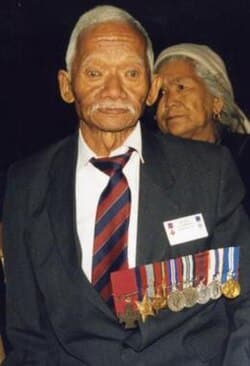
In 2008, five claimants—including Falklands veteran Lance-Corporal Gyanendra Rai, Gulf War veteran Birendra Man, a Gurkha widow, and two Victoria Cross holders: Lachhiman Gurung (then 91) and Honorary Lieutenant Tul Bahadur Pun (then 87)—launched a legal challenge against this policy.
The Joanna Lumley Campaign: A Nation Rallies
The campaign gained national prominence when actress Joanna Lumley, whose father Major James Rutherford Lumley had served with the 6th Gurkha Rifles during World War II (alongside both Gurung and Pun, who had saved her father’s life in Burma), became the public face of the movement.
Lumley’s passionate advocacy, combined with the powerful symbolism of wheelchair-bound VC holders fighting for basic rights, captured the British public’s imagination. On November 20, 2008, she led a procession of Gurkhas from Parliament Square to 10 Downing Street, delivering a petition signed by 250,000 people.
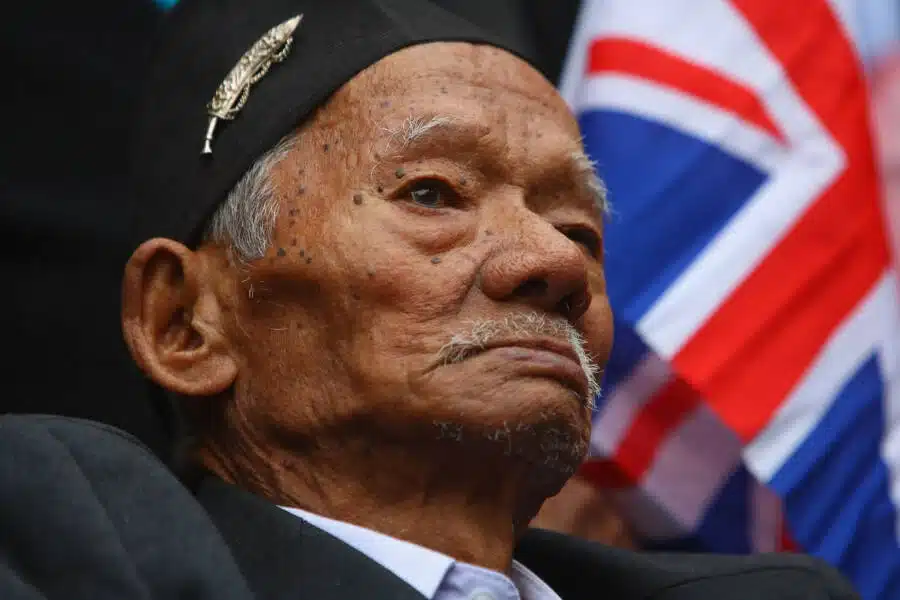
The sight of Lachhiman Gurung and Tul Bahadur Pun, both in wheelchairs, both wearing their Victoria Crosses, both denied the right to live in Britain, proved impossible to ignore. In September 2008, High Court Judge Mr. Justice Blake ruled that the government’s policy should be reviewed, referring to the “Military Covenant undertaken by every British soldier by which, in return for their pledge to make the ultimate sacrifice, they are promised value and respect.”
When the judge delivered his ruling, Gurkhas and their supporters in the courtroom erupted with their battle cry: “Ayo Gorkhali!” (The Gurkhas are upon you!)
The campaign continued through early 2009, with Lumley confronting Immigration Minister Phil Woolas in BBC studios, pursuing him for an impromptu press conference about rejected Gurkha applications. On April 24, 2009, she stated she was “ashamed” of the government’s restrictive criteria. On April 29, 2009, with support from Opposition parties and rebel Labour MPs, Parliament passed a Liberal Democrat motion granting all Gurkhas an equal right of residence.
On May 20, 2009, Home Secretary Jacqui Smith announced that all Gurkha veterans who had served four years or more in the British Army before 1997 would be allowed to settle in Britain.
It was a complete victory.
The Legacy: More Than a Medal
Lachhiman Gurung was one of only 13 Nepalese Gurkhas to receive the Victoria Cross—and one of only 26 VCs awarded to Gurkha soldiers throughout their long history of service to the British Crown. His Victoria Cross is currently held by his parent unit, the 4th Battalion, 8th Gurkha Rifles (now part of the Indian Army), where it occupies a place of honor at the Regimental Quarterguard, serving as eternal inspiration to future generations.
His name is also inscribed on the Memorial Gates at Constitution Hill in London’s Green Park, part of a monument dedicated to the five million men and women from the Indian subcontinent, Africa, and the Caribbean who served in the two World Wars.
But Gurung’s legacy transcends medals and monuments. His story represents the very essence of the Gurkha warrior spirit—a spirit built on loyalty, courage, and an unbreakable will that refuses to yield even when all seems lost.
What Lachhiman Gurung Taught the World
Courage is not the absence of fear—it’s the decision to stand firm despite overwhelming terror. Gurung knew he was likely to die that night. His choice to fight anyway, to hold that position, to defend his comrades, represents the highest form of courage.
Physical size means nothing—when measured against the size of one’s heart. At 4 feet 11 inches, Gurung was smaller than nearly all his comrades. Yet he stood taller than any of them when it mattered most.
Duty transcends self—Gurung could have retreated. Wounded, alone, facing certain death, no one would have blamed him for falling back to the main defensive line. But his sense of duty to his comrades, his unit, and his mission was stronger than his instinct for self-preservation.
Ordinary people can do extraordinary things—Gurung was not a superhero. He was a farmer’s son from a remote village in Nepal. What made him extraordinary was his choice in an extraordinary moment. That capacity for greatness exists in all of us.
Humility is the mark of true heroism—Throughout his life, Gurung remained modest about his achievements. When asked about that night, he simply said: “I had to fight because there was no other way. All I knew was that I had to go on and hold them back. I am glad that helped the other soldiers in my platoon, but they would have all done the same thing.”
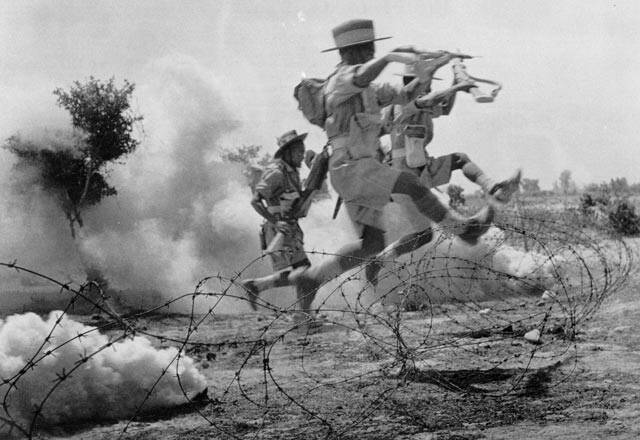
The Gurkha Spirit Lives On
Today, Gurkha soldiers continue to serve with distinction in the British Army’s Brigade of Gurkhas, carrying forward the traditions established by men like Lachhiman Gurung. The selection process remains among the most rigorous in the world, with only a small percentage of applicants earning the right to wear the crossed kukris badge.
The motto of the Gurkhas—“Kaphar hunnu bhanda marnu ramro” (“Better to die than be a coward”)—was never more perfectly embodied than by Rifleman Lachhiman Gurung on that dark night in May 1945.
Honoring the Legend: The Gurkha Watch Connection
At Gurkha Watch, we draw profound inspiration from warriors like Lachhiman Gurung. Every timepiece we create is built to embody the same qualities that made the Gurkhas legendary: unwavering reliability, exceptional durability, precision under pressure, and steadfast performance when it matters most.
Just as Gurung stood firm through four hours of relentless assault, our watches are engineered to perform flawlessly through the most demanding conditions. Just as he operated with precision despite devastating wounds, our movements keep accurate time regardless of the environment. Just as his example inspired those around him, we hope our watches inspire their wearers to face their own challenges with courage and determination.
When you wear a Gurkha watch, you carry a piece of this extraordinary heritage. You wear a reminder that true strength comes from within, that courage is a choice we make in moments of adversity, and that quality—like valor—never goes out of style.
The curved kukri on our timepieces isn’t just a symbol—it’s a promise. A promise of the same dedication to excellence that drove a 4-foot-11-inch rifleman to defend a trench alone against 200 attackers. A promise that when you need it most, your Gurkha watch will stand with you, just as Lachhiman Gurung stood for his brothers-in-arms.
In Memoriam
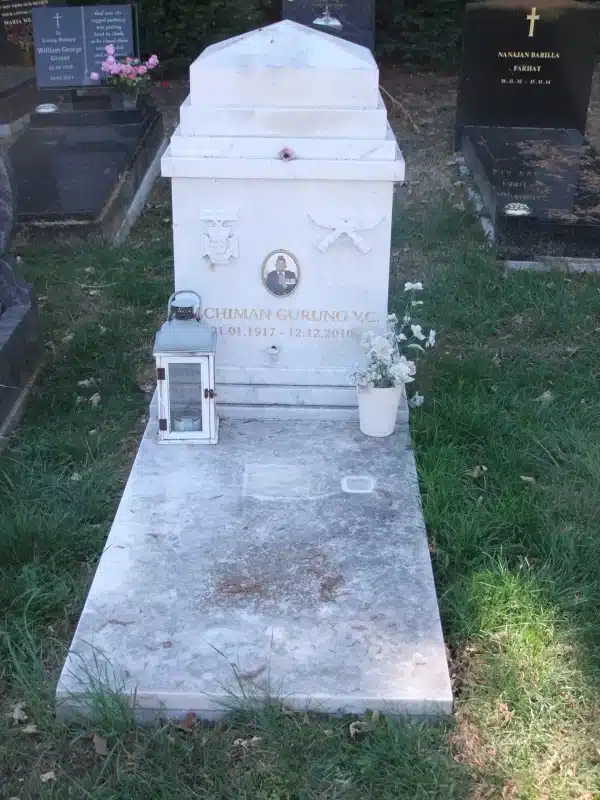
Rifleman Lachhiman Gurung VC
4th Battalion, 8th Gurkha Rifles
30 December 1917 – 12 December 2010
“I felt I was going to die anyway, so I might as well die standing on my feet.”
Ayo Gorkhali! (The Gurkhas are upon you!)